If you’ve been paying attention to the chatter in the Aurora Chasing community, you probably know that the Kp is doing you a disservice.
It’s a measure of geomagnetic activity on a scale of 0 to 9, that is strongly correlated to Aurora activity. It’s also an almost constant feature of Aurora apps, a forecasting tool, and most importantly, a planetary average over three hours.
Try to learn the ropes of Aurora forecasting, and you’re bound to hear this advice at least once: Stop using the Kp. Believe it or not, that’s good advice!
Kp is really only useful when we are making huge generalizations: How strong could Aurora be in three days based on what we know now? What latitude could Aurora reach at its most southern point? How strong did the last major Aurora register on the Kp Index and NOAA’s Geomagnetic Storm Scales?
Using the Kp to catch Aurora in real time, though? Forget it. Or, if you do use Kp during a live chase, be sure to use it in tandem with other sources to avoid a failed search for Northern Lights.
So, what methods of Aurora forecasting work better in real time? There are many ways to tell when Aurora are possible in Earth’s atmosphere. You may find some methods easier or harder to use, based on your experience level and your understanding of space weather terms and solar wind data.
Especially for beginners, I recommend experimenting with different tools and data points, and watching how certain conditions play out in real life where you live. Over the course of time, you’re bound to find a method that works for you. Let’s take a look at some of the resources that can help you dive in.
Using the Ovation Model
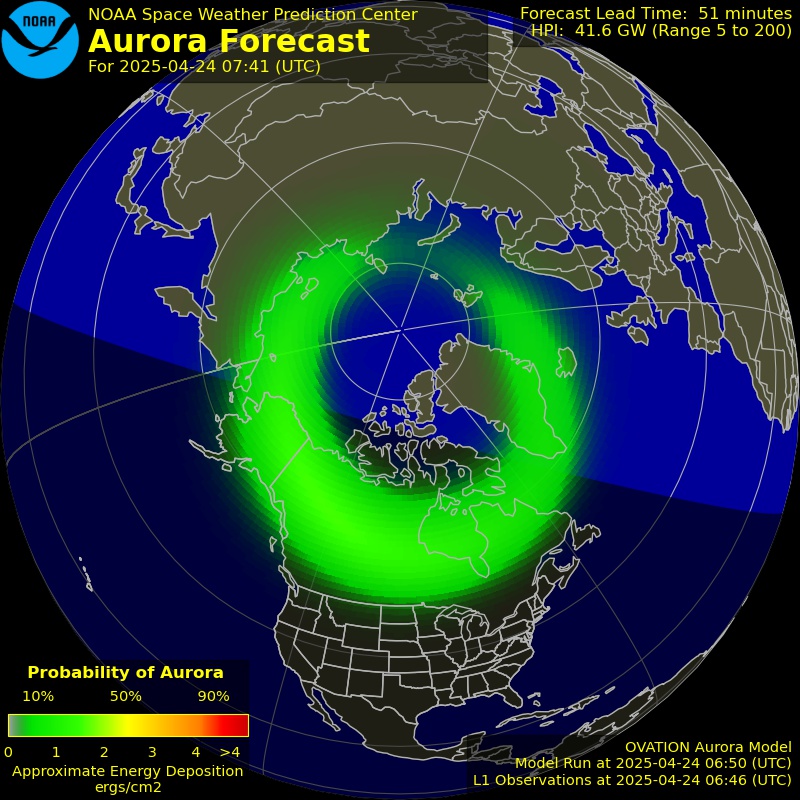
There is one forecasting model I’ve kept at my fingertips almost the entire time I’ve chased the Aurora, and I absolutely love it. When combined with current readings (and frequent updates) of the Bz, the Ovation Model has proven to be an effective tool for Aurora Chasing.
An experimental product, the OVATION Model (Oval Variation, Assessment, Tracking, Intensity, and Online Nowcasting) Model is an empirical model of the intensity of the aurora. The model uses the solar wind velocity and interplanetary magnetic field measured at the L1 observation point located 1 million miles upstream from Earth to calculate three types of electron precipitation and the proton precipitation that is strongly correlated with the Aurora. In the top corner, the forecast lead time denotes the time it takes for the solar wind to travel from the L1 observation point to Earth.
This input is then calculated into the Hemispheric Power Index, which gauges the intensity of the Aurora within 30-90 minutes of when those impacts will reach Earth’s atmosphere. At anything less than 30 gigawatts of Hemispheric Power, visible Aurora are unlikely in the mid-latitudes. Once we see measures of 50-60 gigawatts, or better yet, 80-90 gigawatts, we know that our chances at catching an intense Aurora are greatly improved.
One great benefit of using the Ovation Model is that the projected reach of the Auroral Oval will also be mapped out across the world, with versions available showing the northern hemisphere and the southern hemisphere. If you see the map on the graphic turn bright yellow, orange or red with high probability, we have a good chance of catching the Aurora in the mid-latitudes.
The Ovation Model has become a popular prediction tool for those hoping to catch the Northern Lights. You can find it in many places and in many variations. Versions of this model range from a bold red graphic version, a video version, and a still-image URL that updates constantly. Just know that the video version mostly shows 24 hours of past activity with only a few seconds devoted to future predictions. Then there is a graphic version that exaggerates what Aurora may look like at various strengths, with bold red covering most of the map.
In its most realistic version, the Ovation Model can be found at the link below. This still-image URL can be refreshed any time of day to see updated conditions with their forecast lead time. As long as we have a favorable Bz and reliable solar wind data available, I find the Ovation Model to be a fantastic indicator of incoming Aurora.
Visit the direct link to the Ovation Model:
https://services.swpc.noaa.gov/images/aurora-forecast-northern-hemisphere.jpg
Real-Time Solar Wind Data
With all of the changes in Aurora forecasting apps, websites, technology and sources, real-time solar wind data is rising above other methods as one of the simplest ways to gauge Aurora. The solar wind, of course, is the driving force behind the creation of Aurora.
You can almost compare this space weather to a tornado or a volcano on Earth: It takes a certain set of conditions for the solar wind to become a powerful force and make a visible impact on our atmosphere. On the other hand, space weather is so complex that you would need a degree in astrophysics to fully understand the science.
So, let’s keep it simple. Here is a set of parameters that indicate we are seeing very strong solar winds, and they have the ability to spur the creation of visible Aurora at storm levels.
Solar Wind Speed: 500 km/s (or higher)
Solar Wind Density: 12 p/cm3 (or higher)
Bt: 8 nT (or higher)
Bz: -4 nT (or lower)*
*When Bz oscillates rapidly between southward/negative and northward/positive, this is also a good sign.
Any combination of these factors can change the game, and sometimes only one or two values need to align to produce an Aurora display, especially during the peak season for Aurora. But this will give you a starting point. You can find these values on NOAA’s Space Weather Prediction Center website, on platforms like Space Weather Live, and on many apps designed for Aurora Chasing.
Seek Out Updates on Solar Activity
Whether they realize it or not, Aurora Chasers have a special connection to the sun. The sun is the origin of the most exciting Aurora displays in the mid-latitudes, and we need an active sun to make strong Aurora activity possible on Earth.
Once you become more advanced in your chasing, you can monitor solar activity yourself, track the sunspots and numbered active regions, and be the first to know when high-speed solar wind has been ejected off the sun’s surface. You might come across forecast models like the WSA-ENLIL Model, coronagraphs revealing what the sun looks like at any given time, or experimental research tools like the CME Scoreboard from the Community Coordinated Modeling Center.
Until you get to that level, though, there are some great sources of information out there that you can follow for updates.
Distributing a combination of factual updates, deep scientific or historical analysis, and simple plain-language predictions that anyone can use, these sources will introduce you to a world of space weather forecasting that is both fascinating and, at times, intense. As the scene changes, you can seek out new sources and stay up to date with the latest trends among amateur space weather enthusiasts.
Go check out these sources to get more details on solar activity — which often lead to early alerts about upcoming chances to catch the Northern Lights.
- SolarHam — A great source to follow on social media, SolarHam.com launched on March 15, 2006 with the purpose of providing real time Space Weather news and data from various sources, all in one location for easy navigation.
- SpaceWeatherLive — Providing a robust app that offers a broad range of timely notifications, SpaceWeatherLive.com is an initiative of Parsec vzw, a non-profit organization from Belgium which consists of websites about astronomy, space, space weather, aurora and related subjects.
- Space Weather Prediction Center — The national forecasting agency for space weather forecasting in the U.S., NOAA’s Space Weather Prediction Center offers a wide range of resources from news and updates on their homepage, to satellite data on the ACE Real-Time Solar Wind, the WSA-ENLIL Model, and a free alerts subscription program.
The only way to know for sure whether the Northern Lights are out is to go outside and observe the night sky first-hand. Sometimes brief displays can appear inside of five minutes, especially in the mid-latitudes, so the more you can monitor the sky, the more successful you will be.
Supplement your chase with live sightings posted in real-time on the internet and social media, and try viewing webcams from the region for confirmation when the Aurora makes an appearance.
No matter how many tools you use, nothing can be substituted for a real sighting in real time. Good luck on the Aurora Chasing trail!
Photo by Matt Quinn.
 melissa f. kaelin