Use the 3-day Forecast as a guide, not a planning tool
When novice Aurora Chasers first set out to find the Northern Lights, there’s a lot to learn. Perhaps most important to understanding the chase is this: Forecasting space weather is an emerging science!
This post features a photograph of Aurora low on the horizon with the Milky Way taken at Isle Royale National Park in Michigan, by Jen Selwa of Renditions by Jen Selwa Photography.
We simply don’t have enough data and eyes on outer space to know the whole story behind each instance of solar activity, which creates the solar wind that’s strong enough to create Aurora in the mid-latitudes.
What does the emerging nature of predicting Northern Lights mean for you, as an Aurora Chaser?
• Any advanced forecasts should always be taken with a grain of salt, including the 3-day forecast for geomagnetic activity and including the forecasting admins do for their communities on social media.
• Don’t live and die by the times or percentages in forecasts for space weather or Aurora. These are the best estimates the scientists in the field can make, as they try to demystify the complex weather from space that’s created by solar activity.
• Remember, times in any forecast have a large margin of error, up to +/- 12 hours. And the game is always changing! An individual analysis of each space weather event may include a margin of error of 7 hours, 10 hours, or 12 hours for that specific prediction.
The forecast times are the best estimates scientists can make based on limited data, satellites and space observatories. While models do their best to predict what may happen when an impact reaches Earth, we have little evidence of that any of this activity will affect Earth’s atmosphere until 1-2 hours before a potential Aurora display.
Whether you are watching the forecasts for the arrival of a CME (coronal mass ejection), a predicted blast of solar wind from a high-speed stream, or a forecast of the geomagnetic activity that creates Aurora, the margin of error should factor into your chasing. Times will not be exact. And the margin of error can mean the difference between daytime and night!
• Experimental models still have a place, even though actual readings will always be more insightful. Much of the field is using experimental products, but actual scientific readings of raw data will take you much further in your success rates.
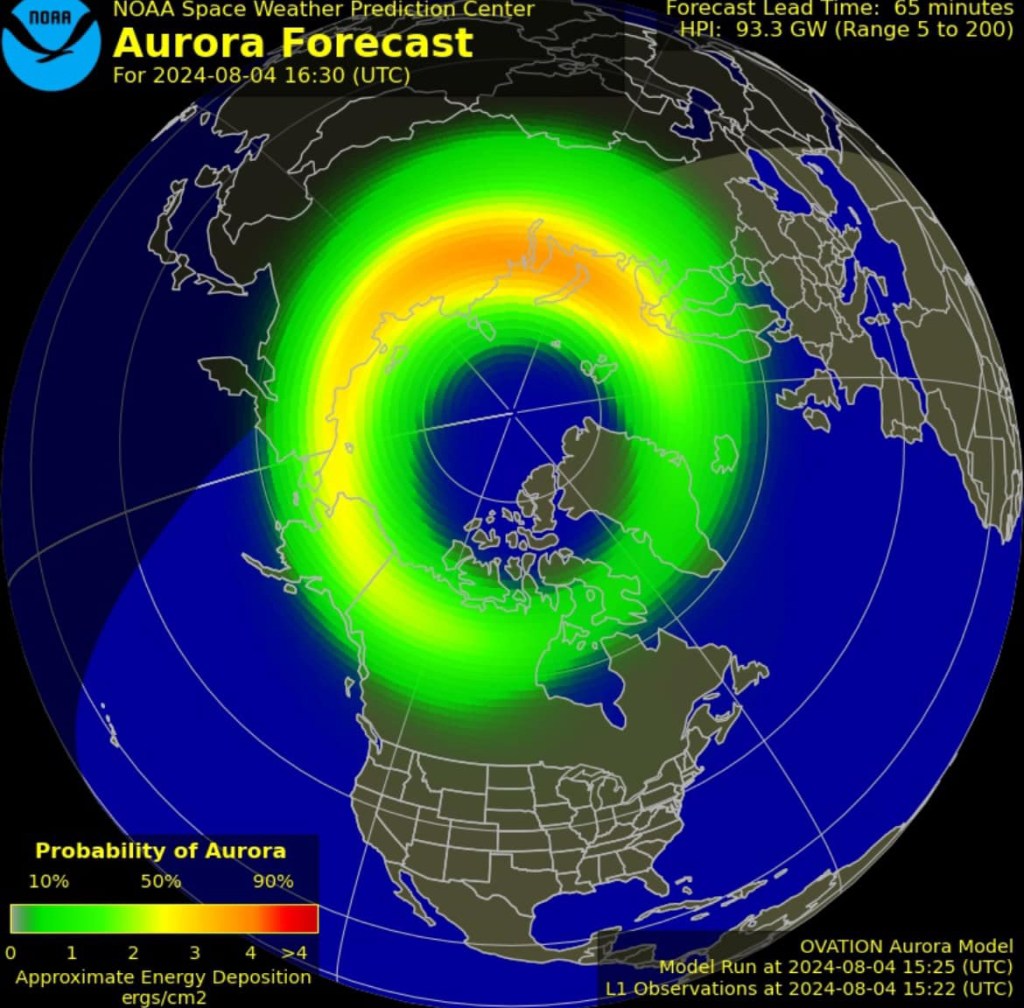
For example, the Ovation Model is an experimental product that uses a combination of factors to make a projection. On the other hand, an example of a scientific tool using raw data is the GOES Magnetometer, which gives actual readings based on conditions that have been observed in space as they approach the Earth.
• If and when we do hit Geomagnetic Storm levels (G Storms), conditions tend to escalate to levels much stronger than what was predicted! This is anecdotal information, found from over 12 years of Aurora Chasing, but it’s my favorite point on this list. Just recently, early on the morning of Sunday, August 5, 2024, G1 Storm levels were reached, then hours later, the conditions launched into G3 Storm levels in the Eastern Hemisphere! The G3 Storm levels were not predicted to occur.
For these reasons and more, we have been posting two types of alerts in the group I founded, the Michigan Aurora Chasers: Chance of Aurora, versus Aurora Predicted.


We could add yet a third option for Camera-Only Aurora Sightings Possible, but under clear and truly dark skies, modern cameras are getting better at catching the Aurora nearly every night, from extremely far distances.
Notice how vastly different that outcome was from the geomagnetic forecast issued for that day, in the examples below.
The SWPC Forecast for August 4, 2024:

The reality observed:
Scientists (and in time, all of us) were able to see evidence of strong geomagnetic storm levels when we observed the actual conditions at the L1 Point in outer space, as shown in a SWPC Alert, and the projected strength on the Ovation Modal, during the time the predicted impact hit Earth’s magnetic field, as shown below.

This brings me to one final tip!
• Try to be excited for the other side of the globe when they get the explosive Aurora we wanted! In time, everyone will get a turn to enjoy dancing skies. We appreciate it when they are excited for us, so let’s be excited for any location that gets to enjoy the Aurora.
So, should we stop using the 3-day forecast for geomagnetic activity altogether? Some say yes. But in conversation with a fellow Aurora community leader recently, I finally found the words I have been searching for all this time.
The mantra is both a note of caution, and a note of hope:
“All forecasts represent an approximation of what is expected based on the data available at the time. No forecasts are beyond challenge, and there is always margin for error.”
— But they do help us to guide our time, and that’s all we ask these forecasts to do. —
When the timing of an Aurora does not correspond with our night skies, we always have the option to watch the displays on live webcams from around the world, enjoying the visuals on our screens during the daytime!
 melissa f. kaelin